Laila was a curious and thoughtful fifteen-year-old, with dark, wavy hair that framed her face and deep brown eyes that seemed to notice everything around her. She had always been drawn to stories of her family’s past and the traditions that connected them, even though she had spent most of her life in the city and had rarely experienced Afghan festivals firsthand. Quiet, but observant, Laila often reflected on the people and events she encountered, carrying a gentle empathy that allowed her to connect with others, even when she felt like a stranger. Today, her curiosity was leading her into something entirely new: Nowruz, the Persian New Year celebrated across Afghanistan to mark the arrival of spring and renewal.
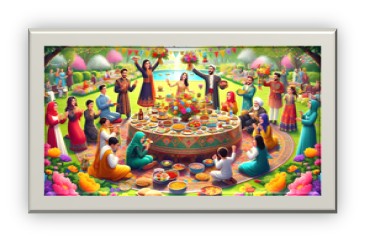
Stepping out of the car, Laila was immediately enveloped by the vibrant energy of the festival. The air was alive with a sensation. The smoky aroma of grilled kebabs mingled with the sweetness of syrup-soaked desserts, and brightly colored fabrics shimmered as families moved with purpose and excitement. Her mother had explained that Nowruz was more than a celebration; it symbolized rebirth, a chance to leave behind the hardships of the past year and welcome hope for the future. Standing there, Laila felt both like an outsider and an observer of something deeply meaningful.
Following her family deeper into the crowd, the steady rhythm of drums began to pulse through the air, drawing her attention toward a circle of dancers. This was the Attan, a traditional Afghan dance performed during moments of celebration and unity. The dancers moved in unison at first, their steps controlled and deliberate, before gradually spinning faster, their energy building with the music. Laila lingered at the edge, captivated by how the movement seemed to tell a story—one of resilience, connection, and shared identity. Nearby, children laughed as they ran between relatives, while elders sat together, exchanging stories over cups of tea. Every detail, from music to the movement, felt intentional, rooted in generations of tradition.
Soon, her aunt handed her a small plate filled with unfamiliar dishes, encouraging her to try them. Laila hesitated before taking a bite of Bolani, a thin, crispy flatbread stuffed with seasoned potatoes and herbs. The flavor was warm and comforting, surprising her with its simplicity. She then tasted haft Mewa, a mixture of soaked dried fruits and nuts traditionally prepared for Nowruz to represent prosperity and abundance in the coming year. As she ate, Laila realized that the food carried meaning beyond taste—it reflected culture, memory, and continuity, connecting those present to their past.
As the sun dipped below the horizon, lanterns were lit, casting a soft golden glow across the celebration. The noise softened into a steady hum of conversation and laughter, and Laila found herself no longer standing apart but gradually blending into the moment. What once felt unfamiliar now felt welcoming. She began to understand that Nowruz was not simply a holiday, but a powerful expression of identity and belonging. Surrounded by music, tradition, and shared experience, Laila realized that even a first encounter with a culture could feel like a return to something deeply human—connection, renewal, and home.